Regulatory Brief
Kenya's New EPR Regulations: Compliance for Businesses
Understanding the EPR Regulations of 2024
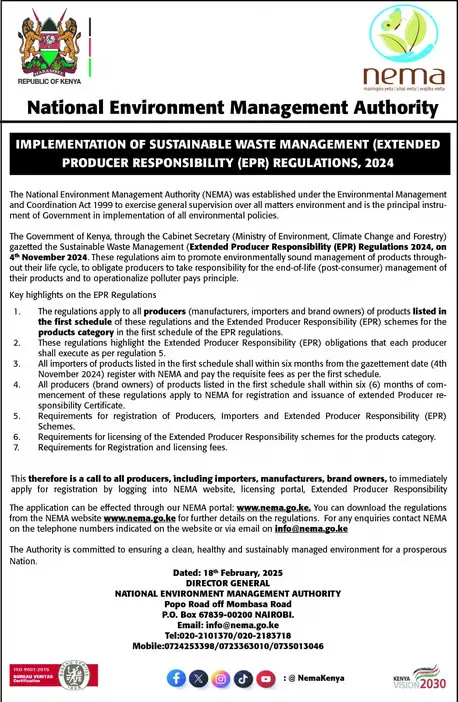
Kenya has taken a significant step towards sustainable waste management with the release of Legal Notice No. 176, the Sustainable Waste Management (Extended Producer Responsibility) Regulations, 2024. This landmark legislation shifts the responsibility of waste management to producers, importers, and brand owners, ushering in a new era of environmental accountability. For businesses (producers), understanding and adapting to these regulations is crucial.
Context
A producer is defined in the Act as an entity that introduces goods, products and packaging into the country using authorized means by manufacturing, importing, converting, filling, refilling, repackaging or rebranding. KEPRO's membership is open to all producers in the plastics, paper & carton, glass, metals, and composite packaging.
Therefore, the EPR Regulations of 2024 are a direct result of the Sustainable Waste Management Act, 2022, and are essential for its effective implementation.
The Sustainable Waste Management Act, 2022 (Access the SWM Act of 2022)
- Provides the overarching legal framework for sustainable waste management in Kenya.
- Establishes the principles and objectives for waste management, emphasizing the circular economy and EPR.
- Creates the legal basis for subsequent regulations.
- Mandates the Cabinet Secretary to create regulations to operationalize EPR principles.
The Extended Producer Responsibility (EPR) Regulations, 2024 (Access the EPR Regulations of 2024)
- Derived from and designed to operationalize Section 13 of the SWM Act, 2022.
- Specify requirements for producer registration, take-back schemes, and fee payments.
- Offer the "how to" for the Act's "what is required".
Access the initial key compliance steps:
- Application Steps for Producer Registration with NEMA - https://kepro.co.ke/news-detail/steps-to-apply-nema-producer-registration-certificate/ (NEMA eCitizen Portal) - one-off
- KEPRO Membership (Renew or New) - https://memberportal.kepro.co.ke (KEPRO Member Portal) - Annual Membership + Monthly Volume Declarations (MVDs)
- Application Steps for NEMA Plastics License - https://kepro.co.ke/news-detail/steps-to-apply-plastic-packaging-materials-license/ (NEMA Licensing Portal) - Annual
The Producer's New Burden (and Opportunity)
The core principle is clear: producers are responsible for the entire lifecycle of their products, including collection, recycling, and proper disposal. This spans packaging, electronics, vehicles, and more.
Key Impacts for Businesses
- Mandatory Registration: Register with NEMA and secure an annual operating license.
- Take-Back Schemes: Establish systems to collect and responsibly manage end-of-life products.
- EPR Fees: Fees set by the Cabinet Secretary fund EPR operations; importers are also liable on listed products.
- Reporting: Maintain detailed records and file annual reports to NEMA and relevant counties.
Compliance Checklist
Registration
All producers (manufacturers, importers, brand owners) must register with NEMA.
Register online: https://nema.ecitizen.go.ke/
Existing producers must complete registration by May 4,
2025.
Take-Back Schemes
Set up collection points, partner with waste managers, or implement deposit-refund systems.
EPR Fee Payment
Declare market volumes and pay resultant EPR fees (see KEPRO's Monthly Volume Declarations & fees here).
Record-Keeping & Reporting
Track volumes, collection, recycling, disposal; submit reports to NEMA and counties.
Join a PRO
Streamline compliance via collective schemes.
Packaging (non-hazardous): Join KEPRO.
Hazardous waste: HAPROK; E-waste: EPROK; other categories are forming.
Key Compliance Considerations
- 📝 Product Design: Prioritize recyclability and material efficiency.
- 📝 Supply Chain: Align suppliers/distributors to EPR expectations.
- 📝 Consumer Engagement: Use labels and campaigns (see KEPRO's CLT "My Waste, My Responsibility!" here).
- 📝 Staying Informed: Monitor NEMA and industry updates for changes.
Consequences of Non-Compliance
Expect penalties and potential legal action. Beyond fines, non-compliance harms reputation and erodes consumer trust.
Role of PROs
- Collective Management: Shared platforms to meet EPR duties efficiently.
- Fee Setting: Based on volume, recyclability, and environmental impact.
- Restoration Fund: 5% of collected membership fees remitted to support environmental rehabilitation.
- County Reporting: Annual reports submitted to counties of operation.
Navigating the New Regulations
The regulations present both challenges and opportunities. Early movers gain a competitive edge; PROs will be central to accelerating Kenya's circular economy.
Key Takeaways
- Compliance is mandatory—register and implement take-back schemes promptly.
- PROs reduce administrative burden and provide technical support.
- These rules signal Kenya's long-term commitment to sustainability.
Looking Ahead
Success requires coordination between businesses, PROs, NEMA, and other stakeholders. Collaboration will build a resilient, circular future.
P.S.
- Source Segregation: National Waste Colour Codes (Green: Organic, Blue: Recyclables, Black: General). Learn more.
- Plastic Packaging Clearances: Re-apply on the NEMA portal per the 14 Oct 2024 packaging regulations. Learn more.
- KEPRO Members: Access the EPR Plan here.
KEPRO remains committed to supporting members to comply with the regulations as we work together toward a circular economy in Kenya. Contact us for clarifications.
"Embracing Circularity
Accelerating Recycling
Closing the Loop"